
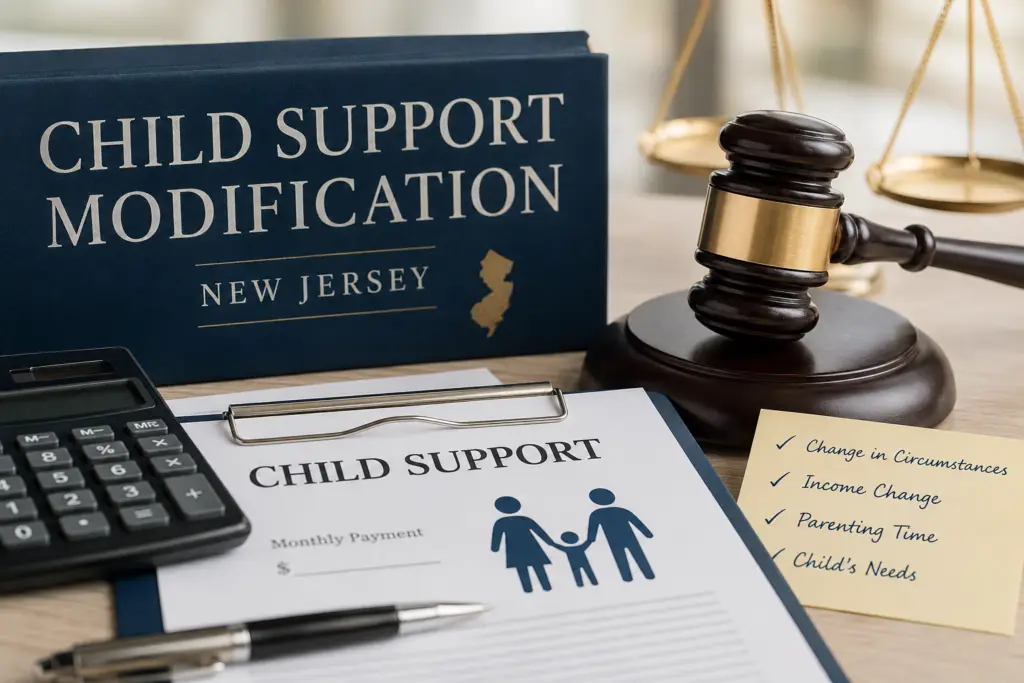
Child Support Modification in New Jersey: When and Should You Request It?
Despite the finality of Superior Court Orders, and even though you may have had a child support order filed with the Family Court, that Court Order may not be final. A child support order that was appropriate when it was first filed with the Court may no longer reflect a parent’s current financial circumstances, the parenting time arrangement or a child’s evolving needs.
Fortunately, New Jersey law recognizes that support obligations and orders may need to be modified when there has been a significant change in circumstance, as well as, a passage of time from when the last support order was calculated. There are exceptions to this requirement: if parties entered into a consent order, or a Marital Settlement Agreement, the parties may agree in that document to periodically review and reconsider the support obligation based on a passage of time, or the happening of an event.
Unless there is an agreement between the parties regarding modification of a support order, modifying child support is not automatic. The Family Court in New Jersey will only approve a modification when an application is properly filed with the Court, and specific legal requirements are met.
By way of example, whether you have experienced a significant change in income, your parenting schedule has changed, or your child now has increased financial needs, understanding the legal standard for obtaining a child support modification in New Jersey is essential before filing an application with the court. For these reasons it is recommended you hire legal counsel.
When Is a Child Support Modification in New Jersey Granted?
Unlike property division, which is final after your divorce, child support orders may be modified when circumstances substantially change. New Jersey courts recognize that financial situations and family dynamics evolve over time, but any modification must be approved through the legal process. The Courts do not recognize unilateral changes to an agreement or court order. Unless both parents agree to a new child support calculation, parents should never assume they can unilaterally increase or decrease their support payments on their own. Until the court enters a new order, the existing child support obligation generally remains in effect.
What Is a Change in Circumstances?
The legal standard for obtaining a child support modification in New Jersey was established by the New Jersey Supreme Court in Lepis v. Lepis. Under the Lepis standard, the parent requesting a modification must demonstrate that circumstances have changed significantly since the existing support order was entered.
Generally, the change in cirumstance must be substantial and continuing, rather than temporary or minor. A change in circumstances may provide the basis to modify child support in NJ when the change is substantial and continuing. Every case is unique, and courts evaluate each application based on its specific facts and supporting evidence. For this reason, hiring an attorney is recommended.
Incorporated in a filing with the Court, the parent requesting the modification has the burden of proving that the changed circumstances justify increasing, decreasing, or otherwise modifying child support.
The Importance of a Prima Facie Showing
The courts have recognized several fact patterns in which a child support modification in New Jersey may be appropriate. However, before the court finds that a change in circumstance has occurred, the Court may order additional financial discovery or schedules a hearing. In order to get to that step, the parent requesting the modification must first establish a prima facie change in circumstances. Having met this standard, this means the litigant has presented sufficient evidence to demonstrate that the request has a legitimate legal basis.
If the court determines that this initial burden has been met, it may require both parties to exchange updated Case Information Statements as well as additional financial information before deciding whether child support should be modified.
Common Reasons to Request a Child Support Modification
Several types of life events may justify a review of an existing child support order. These events may constitute a change in circumstances that allows a parent to seek to modify child support in NJ.
Significant Changes in Income
One of the most common reasons to seek a modification is a substantial change in either parent’s income.
Examples include:
• Involuntary job loss
• A significant reduction in earnings
• Long-term illness or disability that limits the ability to work
• Certain retirements, depending on the circumstances
• A substantial increase in either parent’s income
The court will carefully evaluate whether the change is ongoing and supported by appropriate financial documentation.
Changes in the Child’s Needs
As children grow, their financial needs often change.
Examples include:
• Increased medical expenses
• Therapy or counseling costs
• Special educational needs
• Increased childcare or daycare expenses
• Other significant expenses affecting the child’s well-being
The court may consider whether these changes justify adjusting the existing child support order.
Changes in Parenting Time
Child support is closely associated with the amount of time each parent spends caring for the child.
A modification may be appropriate when there has been:
• A significant change in the parenting schedule
• A change in primary residential custody
• A substantial increase or decrease in overnight parenting time
Because parenting time directly affects child support calculations, significant custody changes often warrant a review of the support obligation.
When Child Support May End Instead of Being Modified
In some situations, the appropriate legal action is not to modify child support but to terminate it.
Emancipation
Under New Jersey law, child support generally ends when a child becomes emancipated. However, emancipation depends on the individual circumstances and does not occur automatically simply because a child reaches a certain age. Emancipation may also be defined in an Agreement between the parties.
Age 19 Presumptive Termination
New Jersey law provides for the presumptive termination of child support when a child reaches age 19 unless an exception applies. In some situations, support may continue beyond age 19 if permitted by law.
College Attendance
Parents are often surprised to learn that college attendance does not automatically extend child support. The child support calculation may be modified depending on whether the child attends college locally or in another state. Questions involving child support and contributions toward college expenses are separate legal issues that depend on the facts of each case. Hiring an attorney will assist in determining whether child support does continue, terminate or is modified.
Children with Disabilities
When a child has a qualifying disability, child support may continue beyond the usual termination date if the legal requirements are met.
What Usually Does Not Qualify for a Modification?
Not every financial change will justify modifying child support.
Life events which the Courts will generally not grant an application for a modification of child support may include:
• Brief or temporary reductions in income
• Seasonal fluctuations in earnings
• Voluntarily quitting a job without good cause
• Intentionally accepting lower-paying employment
• Taking on voluntary debts, such as new vehicle loans, credit card balances, or luxury purchases
The Court’s will often determine should the parent seeking the modification voluntarily reduced his or her income, the court may determine that income should be imputed based on earning capacity rather than actual earnings.
Cost of Living Adjustments (COLA)
Parents whose child support is administered through Probation and the New Jersey Child Support Program may be eligible for periodic Cost of Living Adjustments (COLAs).
A COLA is an administrative adjustment intended to account for inflation. COLA differs from a court-ordered child support modification based on changed circumstances and is automatic.
How to Request a Child Support Modification in New Jersey
While every case is different, and most times an application to modify child support requires the representation of an attorney, the application generally follows several steps.
Step 1: Determine Whether Changed Circumstances Exist
Before requesting a child support modification in New Jersey, it is critical to first consult with an attorney to confirm whether or not the life event, or change in circumstances, satisfies the legal standard.
Step 2: File a Motion with the Court
Should your attorney confirm an application to the Court is appropriate for the parent seeking a modification, counsel shall file a Notice of Motion, a proposed Order, the parent’s Certification, and a legal brief. These documents will set forth the request and the reasoning for the Family Part to review the existing child support order.
Step 3: Exchange Financial Information
Under the Rules of Court, the Family Part court requires the previous filed child support worksheet and Case Information Statement, as well as updated financial documentation, which may include:
• A current Case Information Statement (CIS)
• Recent tax returns
• Pay stubs
• Proof of income
• Other financial records relevant to the request
Complete and accurate financial disclosures are often critical to the court’s decision.
Step 4: Court Review
After reviewing the evidence, the court may:
• Decide the motion based on the written submissions from both parties;
• Order additional financial discovery;
• Schedule oral argument or, when appropriate, a plenary hearing before issuing a decision.
Why Informal Agreements Will Likely Create Serious Problems
Parents sometimes agree between themselves to temporarily reduce or increase child support payments without asking the court to approve the change.
While these agreements may seem practical, they often create significant legal problems for the litigants.
Further, and unless the child support order is filed by the court, the original obligation generally remains enforceable. As a result, unpaid support may continue to accumulate as arrears even if both parents verbally agreed to different payment amounts.
Working with an attorney to obtain a modified and filed support order protects both parents and provides certainty regarding each party’s legal obligations. Ultimately, it is the child or children who are best served.
Why You Need an Attorney for a Child Support Modification in New Jersey
Successfully obtaining a child support modification in New Jersey often requires more than simply telling the court that your circumstances have changed. The court expects detailed financial documentation and persuasive evidence demonstrating that the legal standard has been satisfied.
An experienced New Jersey family law attorney can evaluate whether your circumstances are likely to support a modification, prepare the necessary financial documentation, present your case effectively, and protect your legal rights throughout the process.
Contact Herbert & Weiss, LLP
If your financial circumstances or your child’s needs have significantly changed, you may have grounds to request a child support modification in New Jersey. If you are considering whether to modify child support in NJ, every family’s situation is unique, and understanding your legal options before filing can help you avoid unnecessary delays and protect your interests.
The experienced family law attorneys at Herbert & Weiss, LLP assist clients throughout New Jersey with child support modifications, enforcement matters, and other family law issues. If you believe you qualify for a child support modification in New Jersey, contact Herbert & Weiss, LLP today to schedule a confidential consultation. We can evaluate your circumstances and help you pursue the appropriate legal relief.